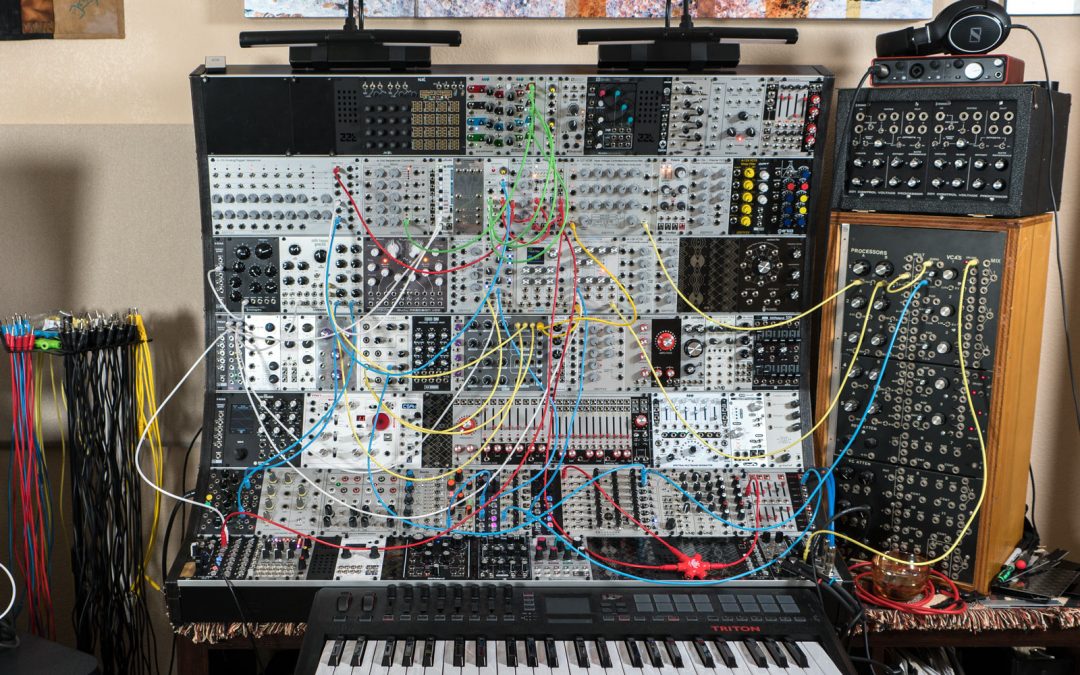
Most of the posts on this site are devoted to smaller modular systems I build for my courses. However, I recently did a 2-hour live webcast with “DivKid” Ben Wilson about my personal system, including many of the choices that went into building it. Here is that video plus some background.
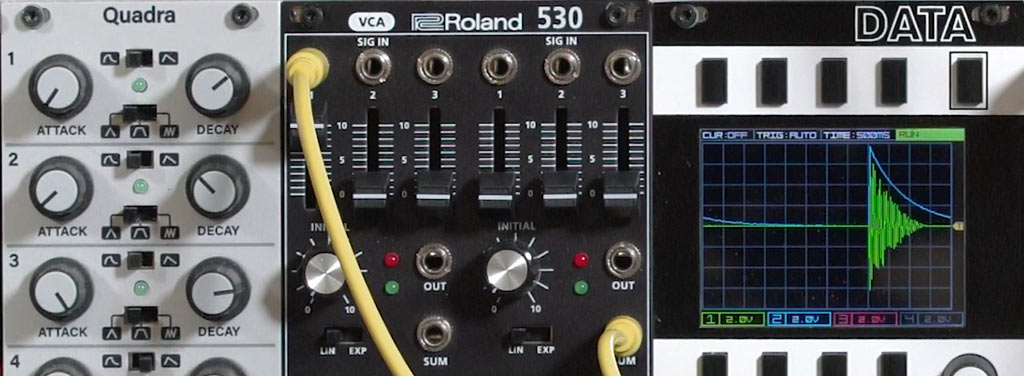
Some VCAs are labeled as having “linear” response, some are labeled as having “exponential” response, and some have a switch or even a continuously variable control to go between the two. Which one should use you use, and when? Of course, the best answer is “whichever...
I created the original Learning Modular Synthesis course for those who were complete beginners to the world of modular synthesis. The next question became: How do I help users reach the next level? The answer is the Eurorack Expansion Project. The idea is you have a nice core system, and want to know how to intelligently expand it – particularly if you interested in a specific technique or are after a certain sound. I’m tackling this in two parts: an online course, and a weekly series – including a dedicated Patreon page for the hard-core users out there.
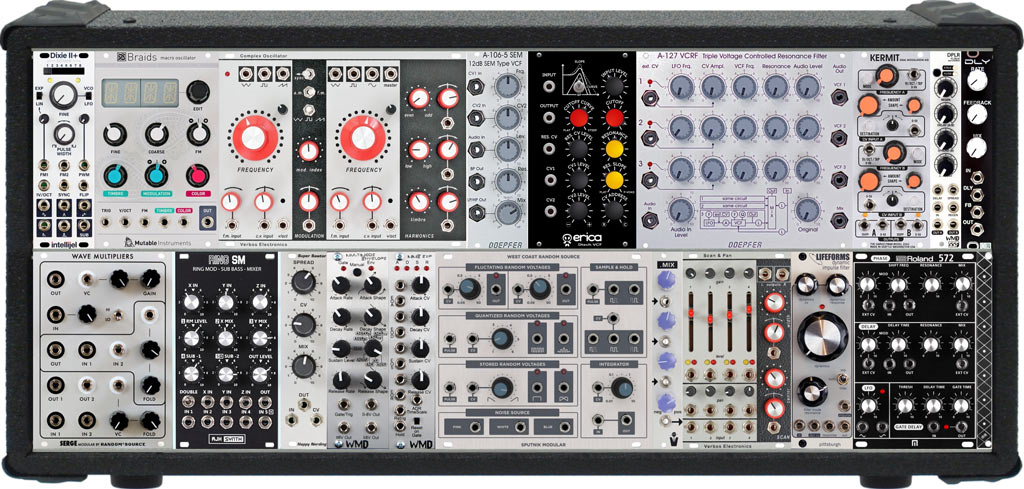
The AJH Synth Ring SM is three modules in one: a ring modulator based on an analog transistor core design, a sub bass generator that creates tones 1 and 2 octaves down, and a 5 input mixer based on the classic Moog CP-3 design. This mixer is used to combine the original inputs, ring modular, and sub bass sounds; you can override them by patching in alternate inputs. The bonus preview movie from the soon-to-be-released Eurorack Expansion course focuses on the ring modulator section, showing a few different applications as well as really focusing on the waveforms and harmonic spectra it creates so that you better understand how a ring modulator works:
The Sputnik Modular West Coast Random Source is a very capable Eurorack-format update on the classic Buchla Source of Uncertainty module. In this movie, I focus first on uses for those 1:2 switches, including using them to send alternating note-on gate or triggers to alternating drum sounds. Then I move on to showing the sample and hold itself, first with the typical “science fiction soundtrack” random pitch technique, and then for something more subtle such as randomly changing the pulse width.