I got to a few more booths today at NAMM 2016 (Malekko, The Harvestman, Sputnik, Snazzy FX, and a return to Intellijel), and wanted to share some more conversations and observations about some of the current directions in modular synthesis – both my own, and from the Meet the Makers panel on modular synthesis.
I’m at the NAMM music show in Anaheim California, and thought I’d summarize some conversations and share some quick impressions of a few of the booths I visited on the first day of the show.
Sometimes, you need to send a signal to more than one place. With Eurorack in particular being a small format to begin with, it’s not common for a module to have multiple outputs to cover you, so you need to find a way to split the signal yourself. There a few ways to do it, some with disadvantages you may not have been aware of.
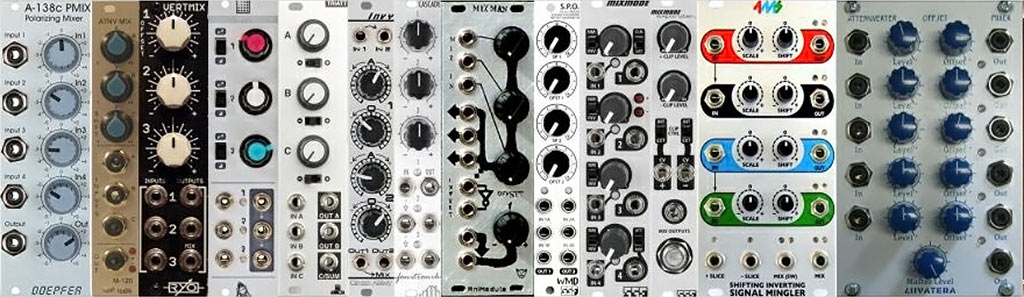
When you’re configuring your modular synthesizer, it’s easy to leave out the all-important utility modules that will help glue together a patch as well as open up creative options. In this note, we’re going to talk about what I call “utility mixers” – not the final mixer with optional effects sends and the such, but tools to combine signals in the middle of a patch.
One of the primary reasons to make the move from pre-configured synthesizers to patchable modular synthesis is the ability to create your own instrument – be it to pick and choose your favorite flavors of synth building blocks, to expand it in ways you prefer, or to explore new signal paths and configurations. A common question is: Where do you start? Keeping in mind there’s no single right answer (and very few wrong ones), here are a few different approaches and their potential trade-offs.