

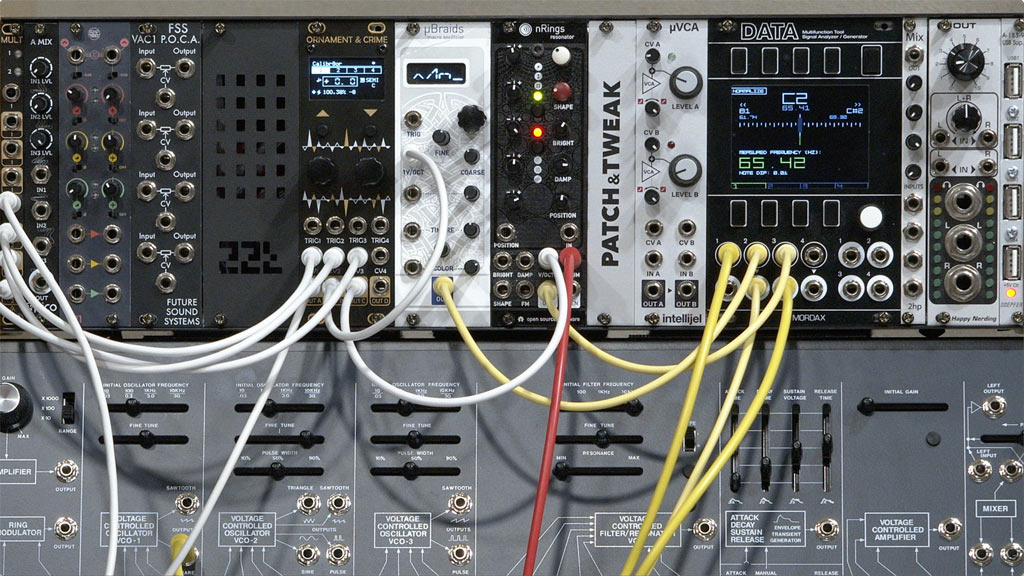
Calibr8or firmware for Ornament & Crime: How To Make Your Oscillators Behave
One of the most maddening things about using a modular synth is how few oscillators track accurately – or at least each other – fresh out of the box. It’s something you think manufacturers would have mastered by now, but they haven’t (partially because so many other...
Learning Modular January 2022 Newsletter: Getting in Tune
I have big plans for 2022: I’ve already tentatively scheduled nine performances at various events, plus I would like to release some new albums. This has meant updating and overhauling my studio, tweaking the Monster (the studio modular) and replacing the Tardis (my...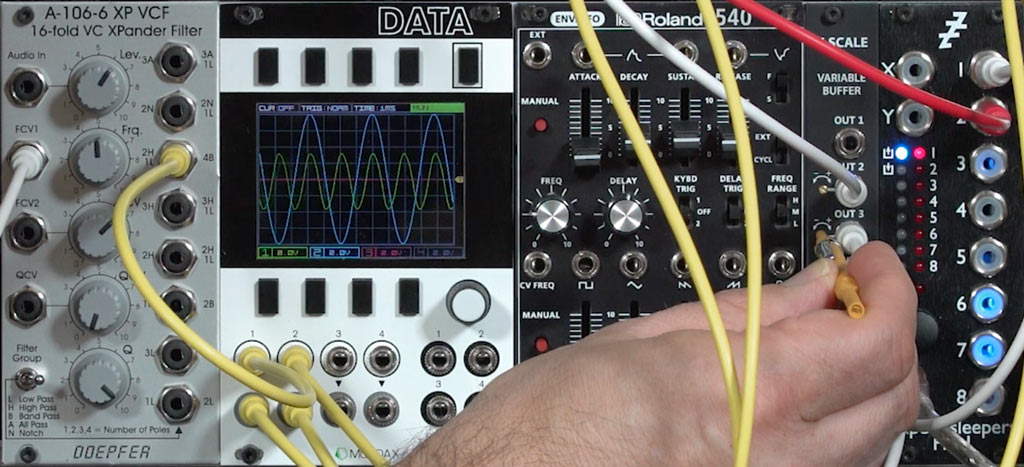
Improving Intonation using the AJH Synth V-Scale
One of the potential challenges of using a modular synth is keeping multiple VCOs in tune with each other as well as external instruments as you play up and down a scale. Most VCOs have trim controls to improve their tracking, but they can occasionally be frustrating to use: They may require you to remove the module from the case to access them, or the manufacturer might have not have used high-precision multi-turn potentiometers for the trimming controls. Therefore, I’ve added several AJH Synth V-Scale Variable Precision Buffers to my modular cases, and have been happier for it. What sets it apart is that 4 of its 5 outputs have high-precision trimmers accessible from the front panel, allowing you to improve the tracking of connected modules like VCOs and resonating filters.

Matching Octaves in Your Modular
Different oscillators and MIDI to CV converters may have varying ideas of what voltage a given note produces, and what pitch should you hear as a result. If there is a difference, in most cases it can be dialed out with a pitch knob or transpose switch. However, there are occasions when you need the assistance of an additional module to settle these disagreements.