

I’m at the NAMM music show in Anaheim California, and thought I’d summarize some conversations and share some quick impressions of a few of the booths I visited today.
Rossum Electro-Music

The Evolution filter is finished and will be shipping in a couple of weeks. The morphing between filter slopes (numbers of poles) is not intended to be like the old Serge design with a smooth change in slope; changing the number poles on Evolution is lumpier, and with a good amount of animation and character – especially with resonance cranked up. E-mu modular synths – the spiritual parent of this new line – was known for their pristine sound; the sound of the new Evolution filter was indeed very smooth and understated – incuding the overdrive was well-behaved. I have an imperfect memory of the price being $369, which is actually less than I was expecting, although still a premium purchase over other less civilized choices. The Morpheus filter and Control Forge CV generator are still unfinished and therefore don’t have prices set. Because of this, I wasn’t able to audition the Morpheus – Dave Rossum was still coding it during the evenings between exhibit hours – but he promised to have online video demos when it’s ready.
Make Noise 0-Coast
 This is intended as a starter table-top semi-modular synth that will be accessible to the beginner (both in ease of use and price – $499), even though it is much more West Coast than traditional East Coast in philosophy – for example, the oscillator goes into an Overtone section with positions on the control labeled as odd harmonics, even harmonics, ¡¡, and !! (no joke – exclamation points). I was pleasantly surprised to hear how incredibly punchy and deep this thing could sound. Make Noise is getting a lot of pressure to do a Eurorack module version of this; although that was not their original vision for this nifty little unit, I have a feeling they may bow to pressure.
Make Noise was also demoing their new Tempi clock module with six simultaneous programmable clock divisions or multiplications, as well as phase offsets from a master clock signal. 64 “states” can be stored in four banks of 16 presets. I’m curious to try it out myself some day – it is billed a being fast and intuitive to use, and I’m always looking for more ways to improvise live with sequencers and the such, but I have to admit the brief demo left me a little daunted as how easy it would be to remember all the different key combinations required.
Roland System 500
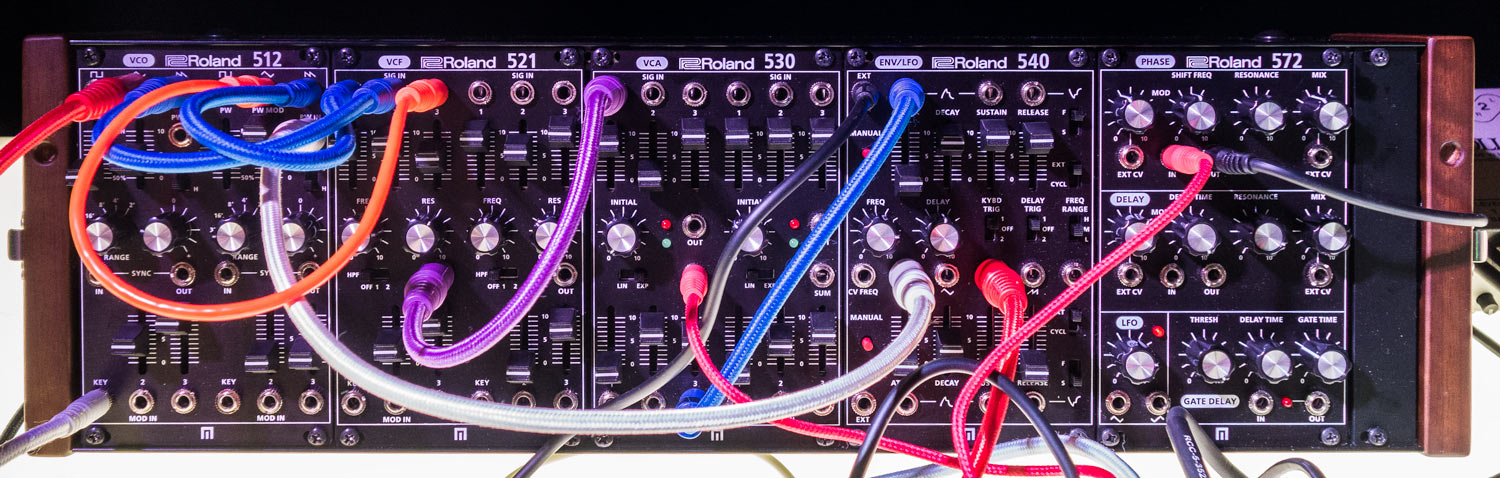
The first batch of System 500 modules sold out quickly; look for better availability soon. Stores that specialize in modular will get the individual modules; more “typical” music stores will get a system with their case, very beefy power supply, the full set of System 500 modules, and some cables for $1999. The more I become familiar with these modules, the more I’m impressed by thoughtful touches such as as the linear/exponential switches on the VCAs, the normalling inside the dual modules (so one pitch control voltage cable, for example, can drive both oscillators if desired), the trigger delay built into the envelopes, etc. These are not do-everything modules – for example, there is no linear FM on the oscillator; the high pass function in the filters is a fixed bass cut, etc. – but they are solid meat and potatoes modules to form the core of a system.
Intellijel
 Intellijel released three new modules: a resonantor (a big recent trend in Eurorack), a compressor (a new trend), and a speaker. Danjel van Tijn related there were more components in the analog compressor (really designed to be a serious audio device) than their other modules. The speaker is pretty serious too, delivering 50w in a bass enhanced enclosure.
While I was there, I talked to Danjel about his 1U tile modules, and why he went away from the format others had been creating to date for tiles. He explained that once you included issues like room for a lip in the rack rails, the system others had been following to date didn’t fit cleanly in a true 1U space, causing some issues for racking. He also made what he felt were other design enhancements in power connection etc., and has offered to share all of his specs with other manufacturers in hopes of establishing a better “standard” before 1U tiles become too big of a market segment to change.
I also spent some serious ear time with the Intellijel Polaris filter. I’m a bit of a filter snob, and I came away thoroughly in love with this filter: really punchy, and very flexible. It kept bringing smiles to my face. I’ve never heard a notch or bandpass configuration in particular that sounded this meaty and musical – it’s on my personal to buy list now.
Waldorf Keyboard and new modules
 Waldorf has been getting a bit of criticism over their new offerings; after chatting for awhile, I’d say they are definitely an expression of a particular philosophy – one that makes sense, even if it’s not the same as your own personal approach. For example, they expect the range of the nw-1 wavetable oscillator to provide much of the timbral variation in a patch, so they’re not offering a standalone filter. But, they are offering a low pass filter as part of the VCA, using the same envelope. It’s not the same as a typical LPG (low pass gate); it’s more akin to the classic East Coast low pass sounds than the West Coast “bongo” sound. The dual envelope & modulation generator seemed nice and flexible with multiple decay stages (another recent theme in modules!) and looping; I requested the loop be back and forth instead of just forward. And, they too have a compressor module now. The keyboard itself seemed to be very well thought out, with MIDI as well as CV/gate, a flexible arpgeggiator, etc. – and there will be an expansion chassis to match. They weren’t publicly releasing prices.
Arturia MatrixBrute
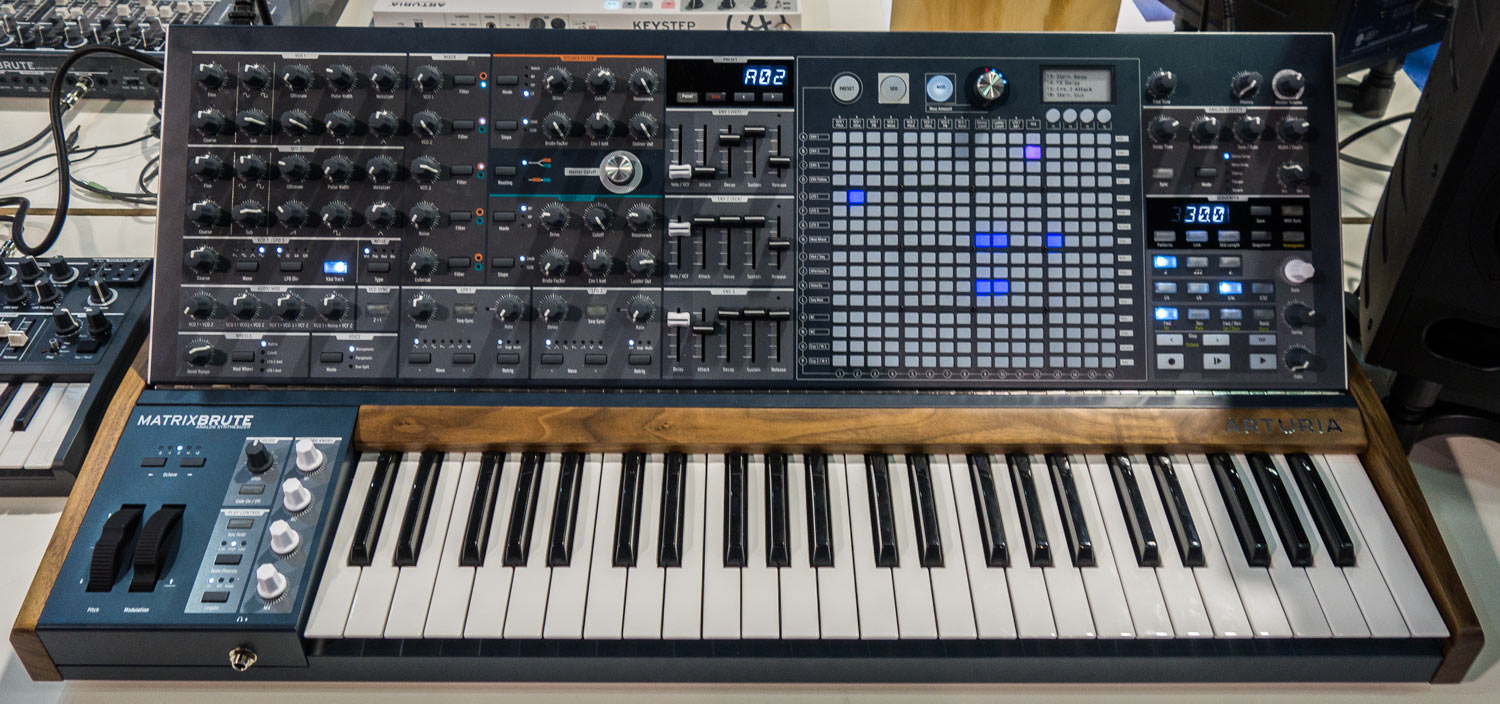 Yes, the MatrixBrute is real (some speculated it was a NAMM rumor hoax based on the idea no one would do that large of a user interface to choose modulation paths on a synth these days). Yes, it’s only $1699, not the $4k some were speculating. Yes, it was heavily influenced user-interface-wise by the obscure Technos Acxel synth of yore. It has three oscillators (2 exponential; 1 linear that doubles up as an LFO with complex waveform choices – it can be both at once, as the LFO runs at a division of the audio oscillator), and two filters (one Steiner Parker based like the other Brutes; one a ladder filter). There are loads of presets. It’s monophonic (with duophonic option), and a ton of patch points on the back panel. The unit is still in development; I did not get a chance to play with it extensively, but what I heard sounded complex and fat.
While I was in the booth we had an interesting conversation about linear versus exponential voltage control oscillators. Although exponential is the far more common standard, they said an analog exponential voltage scaling section can take up to a half hour to become stable; they use a heater in their analog modules to warm up the section faster so it becomes stable in a couple of minutes. The alternatives are all digital, or digitally scaled voltage going into a linear analog voltage control oscillator.
By the way, their new KeyStep mini controller looks really interesting: mini keys, arpeggiator, step sequencer, MIDI, and CV/gate for $119.
Sound Synthesis: Present and Future Panel
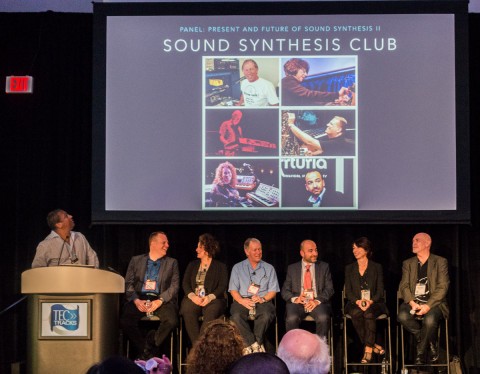 I wrapped up my day by listening to a panel discusion on the history and potential future of synthesis, including (from left to right) Oscar Caraballo of Sound Synthesis Club, Eric Persing of Spectrasonics, Michello Moog Koussa of the Bob Moog Foundation, Dave Rossum of Rossum Electro-Music, Frederic Brun of Arturia, Suzanne Ciani of Seventh Wave, and Michel Huygen of Neuronium.
There were lots of stories told about the develoment of various instruments – including discussion of the importance for constantly evolving sounds to keep the listener’s interest – but the one thing that stuck in my head was Suzanne Ciani saying “in the 60s (when we started with modulars), we knew we weren’t finished yet” – so she’e been happy to see the resurgence of modular of synthesis.