
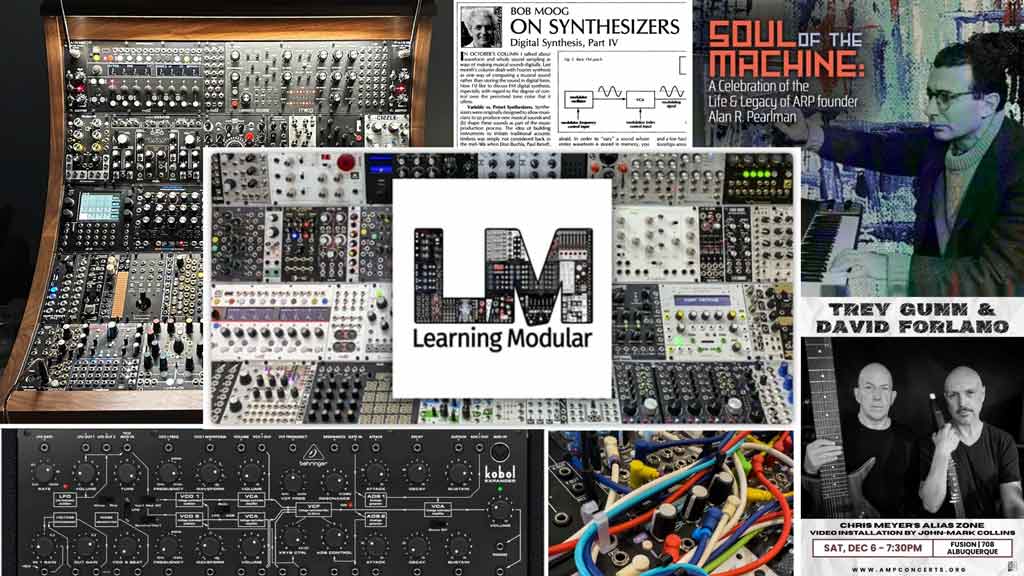
It’s been three months since the last newsletter because a lot has been going on, as shown by the contents of this one. Topics include:
- featured article: I share the philosophy behind this year’s Bob Moog Foundation modular system they are raffling away, including every component I selected for it.
- Alias Zone updates: At the Knobcon show this past September, I previewed a new downtempo direction that I’ve been experimenting with. Both a video and extended play “single” are available. I also played a major role in the Alan R Pearlman Foundation 100th anniversary compilation album.
- Learning Modular updates: My Learning Modular website is 10 years old now! To celebrate, I’m offering all of my online modular synthesis course at 40% off – but only for the first week of December….
- Patreon updates: I’ve written another set of articles for my Patreon subscribers – many centered around the master project I’ve built and what I’ve learned from my recent performances.
- upcoming events: My last performance of a busy year will be December 6, opening for the new duo of Trey Gunn and David Forlano.
- one more thing: My wife is offering direct pricing with flat rate shipping on my Chaos Clips cable organizers.
Now let’s get to the details…
Bob Moog Foundation 2025 Eurorack Modular Raffle

Last year, with the help of numerous manufacturers big and small, I put together a Eurorack modular system for the Bob Moog Foundation to raffle off as a fundraiser to support the Bob Moog Archives, Dr. Bob’s Sound School program for kids, and the Moogseum in Asheville, North Carolina.
No one knew how it would be received…but thanks to people like you, it became one of their most successful raffles ever. So as you might guess, they asked me to do it again. And again, thanks to the wonderful companies in the our little slice of the world, we’ve not only put together a system worth over $24,000 USD – we have second and third place prizes as well!
If you’re already saying “shut up and take my money!”, click here to buy raffle tickets – they are $25 each, and cheaper in quantity (which you will want to buy, to improve your chances). But do so by December 19, when the raffle closes.
Want to learn more about this year’s system? Click here to see the rack on ModularGrid, and read on…
What Would Bob Do?
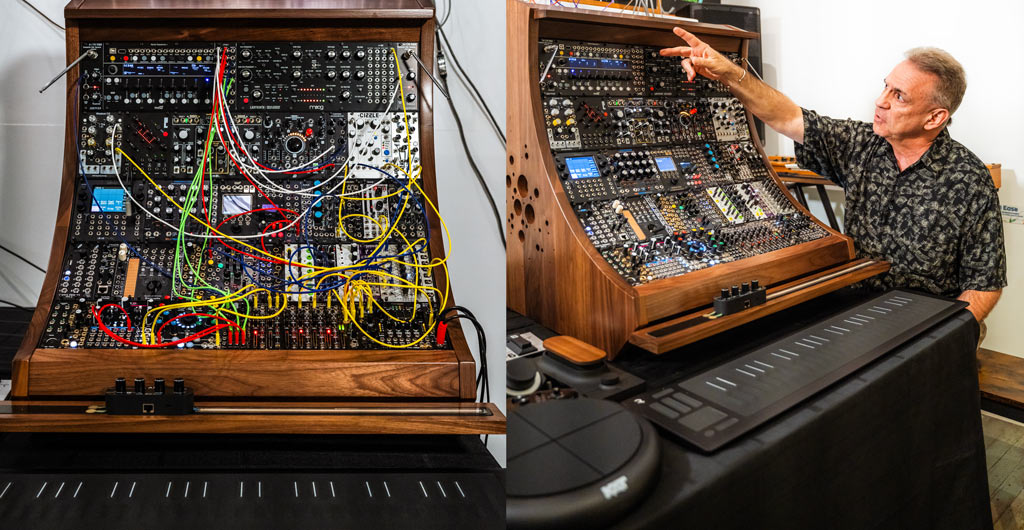
Last year’s system was designed to pay homage to the original Moog modular systems for the 1960s and 70s. The theme of this year’s system is: What Would Bob Do?
To start, Bob Moog had a strong interest in alternate controllers. These ranged from the Theremin kits he originally sold, to the iconic ribbon controller, and even a percussion controller he offered for his modular system.
All of these are included in this system: from a pair of Doepfer A-178 Theremin CV Source modules (so you can recreate the pitch and volume controls on the original Theremin), to an assembled Biopower Audio Axe & Razor ribbon controller, to a Kat Percussion KTMP1 Multipad Drum pad controller + sound module including their KT-HC1 Hi-Hat Controller and KT-KP1 Bass Drum Trigger (we’re throwing in a kick pedal as well). We also added a Bela Gliss Touch Control module to continue the ribbon controller theme.
To convert the MIDI output of the Kat to trigger signals for the modular, Erica Synths donated one of their now hard-to-find MIDI to Trigger modules, which I programmed to work with the Kat. And as for sounds to trigger, this system has both ModBap Modular Trinity and vpme.de Quad Drum sound modules, providing a wide variety of sounds and percussive synthesis techniques.
Later in his career, Bob spent a lot of time working on multi-touch keyboard controllers. To represent that idea in this year’s system, ROLI donated one of their Seaboard 2 multi-dimensional keyboard controllers. To interface it with the modular, Expert Sleepers donated their FH-2 ‘factotum’ MIDI to CV module plus FHX-8CV expander. I programmed these to cover the pitch, gate, velocity, aftertouch, and Y dimension movement each of the ROLI’s keys can produce, as well as its three touch sliders and XY touchpad.
But we didn’t stop there! Manufacturers had their own suggestions on alternate controllers we might also want to include with this system. ADDAC System donated an ADDAC307 Heart Sensing module (so your heart rate can now control your tempo!) and Erica Synths donated a Black Joystick 2 four channel joystick controller with built-in modulation plus drone sources.

Expressive E also stepped up big-time for this year’s raffle. Not only did they donate one of their Touché expression controllers for the main system the Foundation is raffling away, they also donated a 49-key version of their Osmose MPE hardware polyphonic synthesizer plus Noisy 2 MPE software synths for second and third prizes! Bjooks also donated a copy of Push Turn Move as part of the main prize, which covers the user interface design evolution of synthesizers over the years.
Synthesis Methods
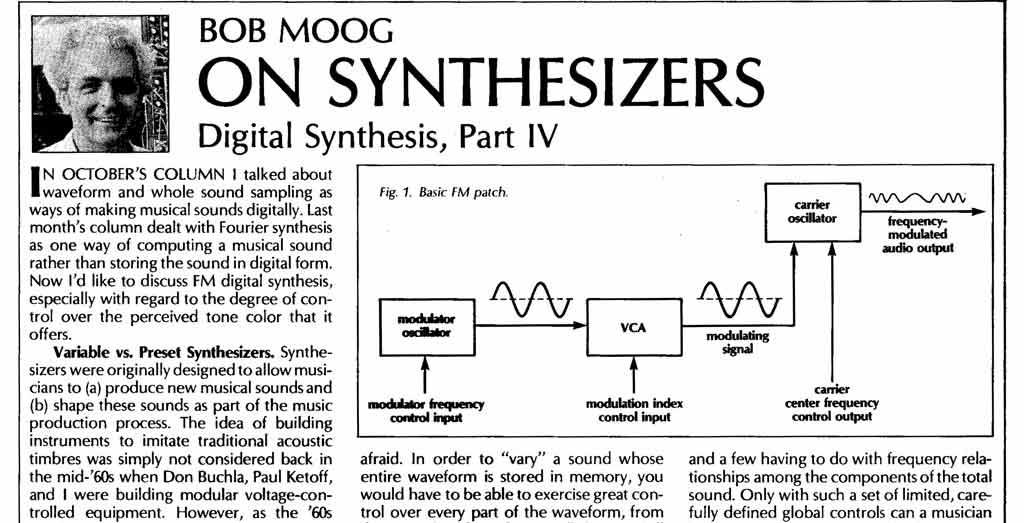
Bob’s story does not end just with controllers. He wrote a number of columns for Keyboard magazine discussing a variety of synthesis and other sound-generating techniques, including sampling, additive synthesis, resynthesis, granular synthesis, Karplus-Strong, VOSIM, frequency modulation, phase distortion, and more. All of those techniques are covered in this year’s system.
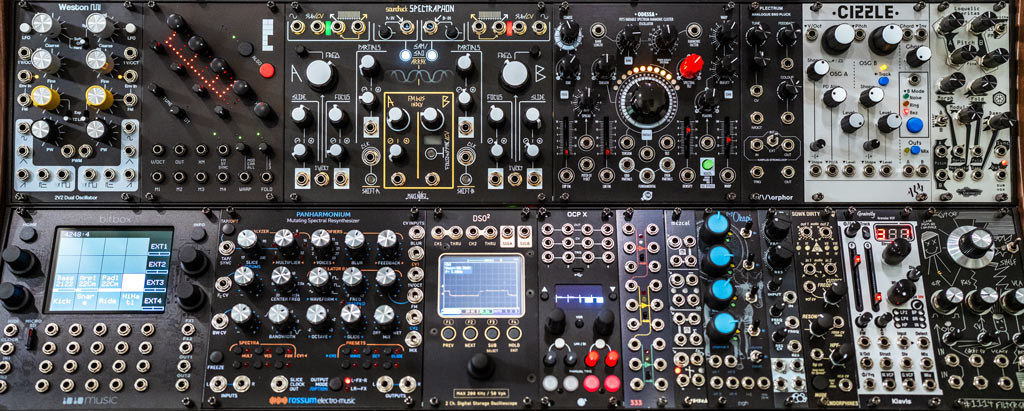
Starting with sampling, 1010music donated a Bitbox 2.0 sample recorder and player with touch screen interface – my personal favorite Eurorack sampler. On the additive synthesis front, we have a Xaoc Devices Odessa digital additive oscillator (which I also have in my own studio modular). And on the resynthesis front, we have two different approaches: the Rossum Electro-Music Panharmonium Mutating Spectral Resynthesizer (the first black panel version made, signed by Dave Rossum on the back), and a Make Noise Spectraphon Dual Spectral Oscillator.
For frequency modulation, again we included two different approaches. On the analog side, we have a Weston Precision Audio 2V2 Dual Analog Oscillator with both exponential and through-zero FM. On the digital side, we have the RYK Modular Algo Quad Complex Oscillator Bank, which includes a Yamaha-style four operator phase modulation voice with the addition of wave folding and a stereo chorus. I love the Algo’s unique visual interface that shows the algorithm patching options between the four sound sources. On the phase distortion front, we have an ALM Busy Circuits Cizzle Dual Phase Distortion VCO inspired by the Casio CZ series.
Again, we didn’t stop there. Noise Engineering donated one of their Loquelic Iteritas multi-algorithm digital oscillators featuring phase modulation, VOSIM, and Summation Synthesis, with the addition of wave folding and variable sample rate. And to round things out from Bob’s columns, Morphor donated a Plectrum Analogue BBD Karplus-Strong module for plucked string sounds.
What about granular synthesis? Again, we have a few different takes on that idea for this system. After Later Audio donated their Typhoon combination of the classic Mutable Instruments Clouds granular module with the popular Monsoon and Microcell clones of it. Klavis has gone in a different direction with the granular synthesis idea with their unique Grainity Granular VCF, applying the original micro sound idea to switching between different filter outputs. The Bitbox 2.0 also includes granular processing.
It is also common to process external sounds through a modular synthesizer, so we included and Instruō làrach input module paired with a Boss FS-6 dual footswitch to control it. All of these different sound sources show just how flexible and powerful a modular synth can be compared to typical preconfigured synths.
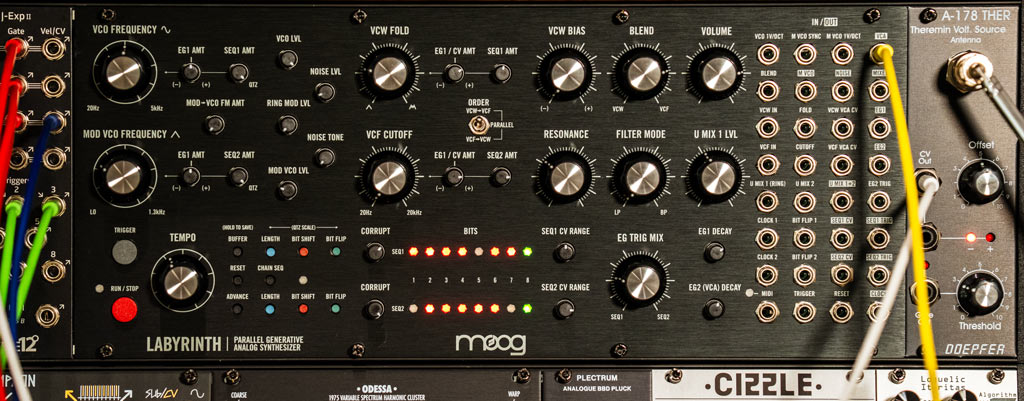
The concept of “What Would Bob Do?” also applies to the company that still carries his name today: Moog Music. Now owned by InMusic, they have been wonderful supporters of the Bob Moog Foundation, including donating one of their Labyrinth Parallel Generative Analog Synthesizers which incorporates new-for-Moog ideas like shift-register-inspired generative sequencing (similar in concert to the Klee or Turning Machine modules in Eurorack), wavefolding, and a state variable filter in contrast to their normal transistor ladder design. It’s a semi-modular synth that you can use standalone, or patch it with the rest of the modules in this amazing system.
Sequencers
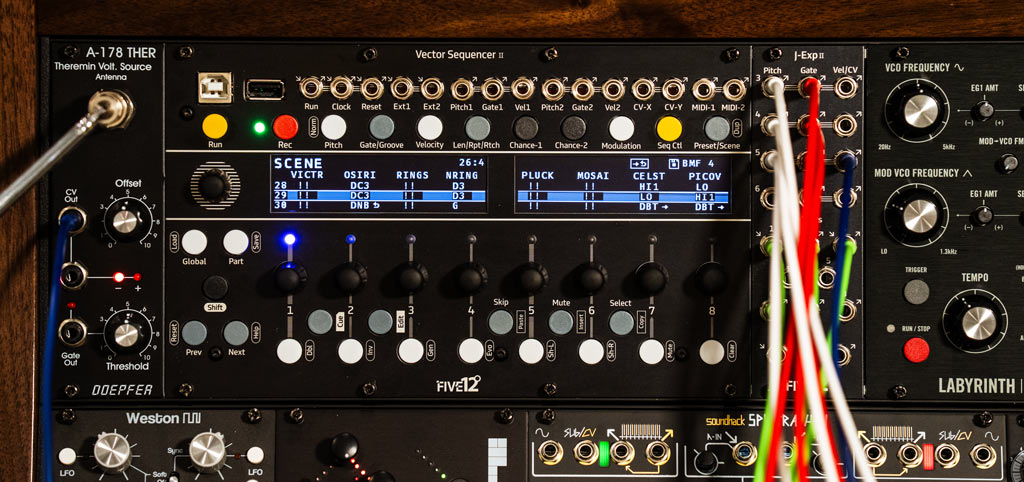
In addition to the two sequencers in the semi-modular Moog Labyrinth, we have two other sequencers in this system as well.
Up top is are the latest “mark II” versions of the Five12 Vector Sequencer plus Jack Expander. I personally have been a Vector Sequencer user since day one, feeling it is the best combination of traditional analog layout (another nod back to the original Moog modular) with digital power (a nod to what Bob might be doing today). I have a Vector plus Jack Expander in both my studio and live performance systems, and it’s central to the way I compose and perform.
Along the bottom row of this system – next to the percussion modules – is a Pusherman µGrids clone of the Mutable Instrument Grids. Grids was one of the earliest percussion pattern sequencers in Eurorack, and is still my personal favorite; again, I have one each in both my studio and live performance systems. In addition to driving the Trinity and Quad Drum percussion modules (not to mention the Bitbox), I also personally patch Grids to the Vector’s Jack Expander to get interesting rhythmic timing of my melodic sequenced parts.
Filters, Amps, Mults, and Mixers
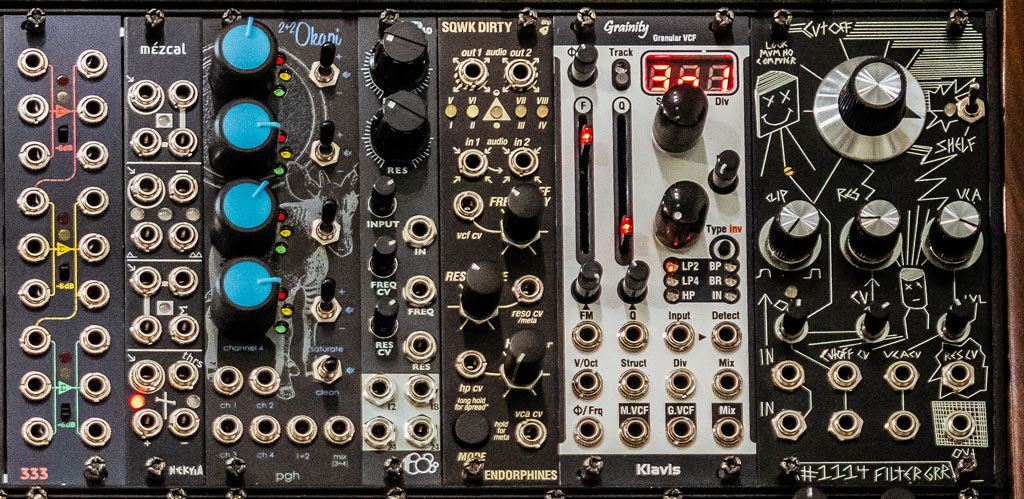
The sound sources with their different synthesis methods are obviously the stars of this synth – but you also need a strong supporting cast to create a truly great modular orchestra.
For example, we have a nice assortment of both digital and analog filters in this system. I already mentioned the Klavis Grainity; beyond its trick of switching between different filter outputs on different cycles of the waveform, it is an analog multimode filter under the hood, complete with normal filter outputs in addition to the granular one.
Adding to the analog character, we have a Hack Modular/Look Mum No Computer #1114 Filter GRR with built-in VCA. It’s been designed to create unexpected sounds from its LM13700 core, including reacting differently to unipolar versus bipolar waveforms. If you prefer something with a smoother analog sound, we also have a Bubblesound Instruments LP40 low pass filter based on the SSI2140 chip (which itself is based on the legendary SSM 2040 filter chip from the 1970s and 80s).
On the digital side, we have the stereo Endorphines Squawk Dirty To Me with eight different filter recreations – including the classic Moog 4-pole transistor ladder low pass design. It too has a built-in VCA, along with a hi-pass filter to tame the subsonic frequencies (DJs know what I’m talking about) and a stereo widening circuit.
In front of these we have a Pittsburgh Modular 2+2 Okapi dual filter mixer, which can act as a pair of 2-1 mixers or a single 4-1. It also includes mute/phase switches, and is also switchable between clean and soft compression/saturation modes.
To the left of that is the very flexible Nekyia Circuits Mezcal analog utility module. It can act as a half or full wave rectifier (creating those unipolar waveforms that the 1114 Filter GRR reacts to), a three channel mixer where each channel has a hard-wired gain of 1/3 (great for mixing together multiple oscillators or waveforms without clipping), a buffered multiple, and a bipolar comparator for analog logic functions. And to the Mezcal’s left is a Frap Tools 333 that acts as both three-to-one mixers and one-to-three buffered multiples – in triplicate – along with handy -6dB switches to again keep clipping at bay.
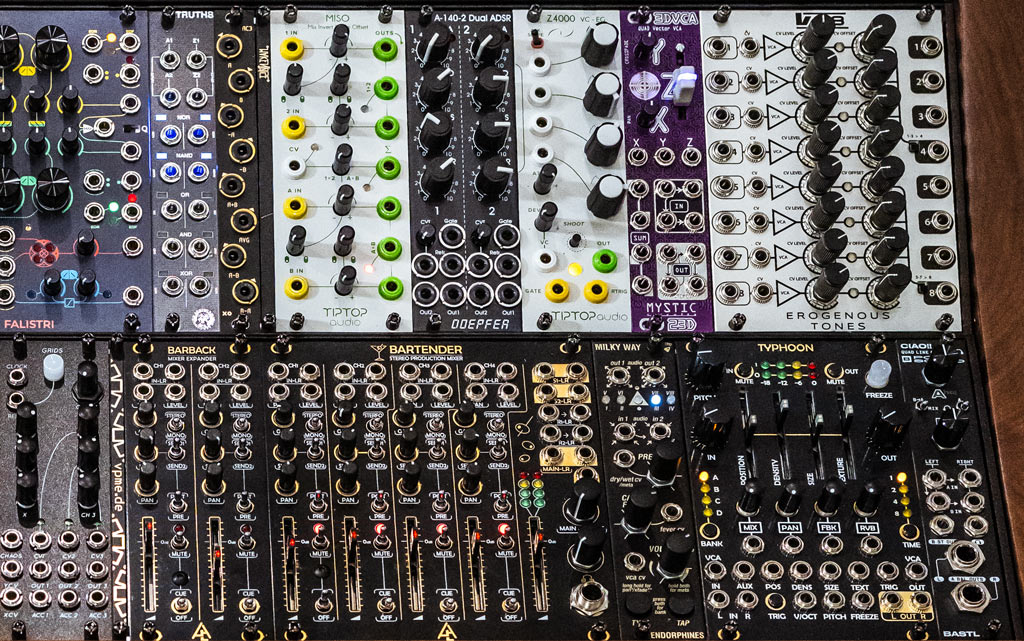
We also took to heart the saying “you can never have enough VCAs.” In addition to the filters with built-in VCAs, we have two additional flexible VCA modules in this system. The purple wonder is a Mystic Circuits 3DVCA which can act as a quadraphonic crossfader, a pair of stereo crossfaders, a stereo VCA, a voltage controlled stereo or quad panner, and more. Alongside it is an Erogenous Tones VC8 with eight linear VCA sections featuring level and offset per channel, as well as clever semi-modular patching which allows it to be used a voltage-controlled mixer.
Speaking of mixers, we did not forget the final output stages! The generous folks at After Later Audio also donated their Bartender Stereo Performance Mixer plus Barback Expander. Each channel can be stereo or mono, plus it has two stereo effects busses. For those effects, we’ve included the After Later Typhoon mentioned earlier, as well as the Endorphines Milky Way stereo digital multi-effects module.
For the final output, we have a Bastl Instruments Ciao!! with both balanced and unbalanced outputs. It features a clever routing system where you can cue one sound in your headphones while sending the final mix out to the main house sound. Taken all together, this system is ready for both studio and live performance duties.
Modulation & Utility

You need modulation sources to drive all of those cool oscillators, filters, and amplifiers – and we made sure you were covered there as well.
For starters, this system has three ADSR and two AD/AR envelope generators. The Doepfer A-140-2 contains two ADSRs with voltage control over rates in each half, plus jumpers to customize the module’s behavior. A Tiptop Audio Z4000 provides the third ADSR, with voltage control over each individual stage as well as output processing.
The Frap Tools Falistri provides two very flexible function generators that can also loop and be used as oscillators. But it doesn’t stop there: The Falistri also has a ring modulator, slew generator, and a pair of flip-flops for dividing down clocks or skipping triggers.
On the modulation front, in addition to being able to loop the Falistri’s function generators, we have a DivKid/Instruō øchd eight channel LFO. Instruõ also included an øchd expander, which bends the triangle outputs from øchd into a wide variety of shapes, triggers, and stepped outputs. If you prefer something focused on the random side of modulation, we also have a Złob Entropy2 which is both a smooth and stepped (sample & hold or track & hold) random voltage generator as well as noise source.
For even more modulation and control voltage sources, this system also has a Plum Audio OCP X: their expanded version of the classic Ornament & Crime module with attenuators, trigger buttons, and alternate voltage output ranges. It comes loaded with the full Phazerville Suite of apps for O_C, including the Calibr8or tuning correction app I commissioned DJ Phazer to write.
You also need ways to process those voltages to bend them to your required purpose. We have a Tiptop Audio MISO for classic Mix, Invert, Scale, and Offset functions. In addition to the Nekyia Circuits Mezcal mentioned earlier, we also have a XODES AC3 Analog Computations module which includes inversion, addition, average and subtraction functions. And sometimes you need a binary logic module for processing triggers and gates; those functions are covered by a hard-to-find Mehr Music Machines Truths.
Those who have seen my courses and other instructional videos know that I believe strongly in having an oscilloscope module so that you can better understand exactly what is going on inside your system, revealing what each module is actually doing. Tall Dog stepped up and provided a DSO2 Dual Channel Oscilloscope, which is placed right in the middle of this system (same location as the ‘scope in my own studio modular).
Case & Power
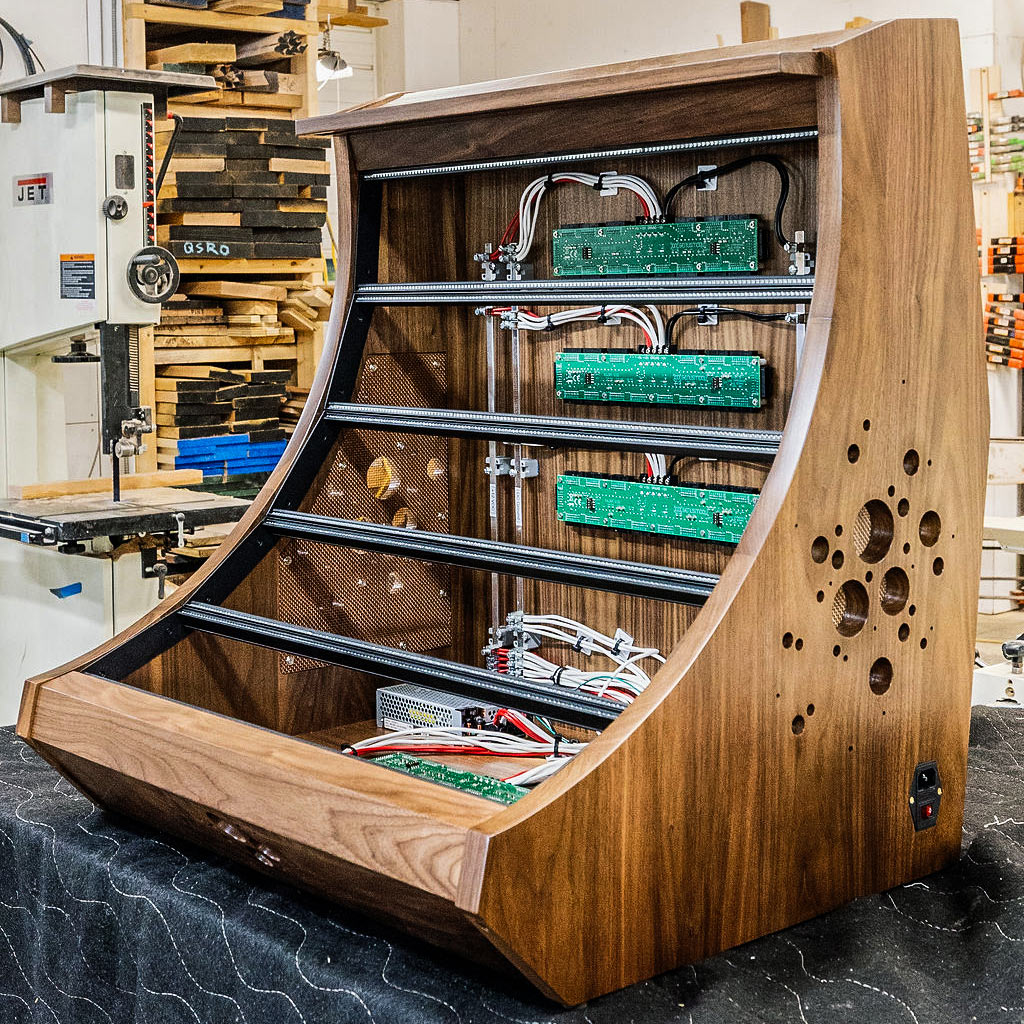
All of these modules need a home – and the case and accessories for this year’s system are equally amazing.
The robust walnut case itself was made by Chris Perryman of Goldsplinter Woodworking Studio in Asheville, North Carolina – same as the home for the Bob Moog Foundation and the Moogseum, all of whom were struck by Hurricane Helene last year. He has a lot of experience building contemporary furniture and objects, but this was his first modular synth case – and he truly excelled.
We love his many touches to this case, including the “scattershot” holes which are his trademark: In addition to looking cool, they provide important ventilation. There is also an integrated light strip along the top (which you see in action in the very first photo at the top of this post), and the custom ribbon controller holder that fits into the bottom section (which you see in the second image above).
The power system is also absolutely top-notch, put together by John Loffink of Genus Modu. John donated a set five of his LIBBs (Low Impedance Bus Boards) which is the lowest noise solution I’ve personally tested for Eurorack systems. He drove to Asheville and personally put together the bus bar power distribution system.
John also put us in touch with Daitron, who creates medical-grade switching power supplies which we used for the +12v and -12v rails. These units have noise levels that approach heavier, hotter linear supplies. The units Daitron donated supply this system and immense amount of headroom. Finally, Klavis donated a set of their NoDrain bus board power inserts which create clean +5v feeds from the often-underused -12v rail.
Hardware-wise, Modular Synth Lab donated the classy black aluminum rack rails, and Befaco donated their Knurlies to mount all of the modules with. Finally, Luigi’s Modular Supply (distributed by my brother Ronald at Starving Students Music Supplies) donated a full set of patch cables as well as a few extras to help interface this system with its external sound sources and destinations.
You Won’t Be Bored
Some instruments can be figured out and fully explored in a matter of weeks, days, or even hours. That is certainly not the case with this system. It is so rich in its varied sound synthesis and processing techniques, sequencers, and alternate controllers, that this instrument will be a companion that you can continue to explore for years to come. And of course, it’s still a modular: if there are parts that don’t quite mesh with they way you like to create, swap modules of your own choice in their place.
Pretty much any single component of this system is worth buying a $25 USD raffle ticket for to try to win. As mentioned above, all together this system is worth over $24,000 USD, certainly making it worth buying multiple tickets for! And if you don’t win this first price, remember that we also have second and third place prizes from Expressive E: an Osmose keyboard, plus their Noisy 2 software synth. And even if your ticket is not pulled, know that your donation is helping keep alive an extremely important part of electronic music history, and sharing it with the generations to come.
Alias Zone Updates
September was one of my busiest months traveling and performing, starting with my set in the Chill Out Room at the Knobcon show near Chicago, Illinois. I used the occasion to debut a new downtempo style I have been experimenting with. The video from that performance is above; I also released the stereo version on Bandcamp at name-your-own-price. Since the original performance was in quad, I have been using this as the first test piece I mix in Dolby Atmos. I plan to release it later this winter through Apple Music and other streaming services.
 October saw the release of another project I’ve been working on since last year: Soul of the Machine – A Celebration of the Life & Legacy of Alan R Pearlman. Alan would have turned 100 this year, and Steve Roach came up with the idea of releasing a compilation album of music old and new that prominently features ARP synthesizers and their approved emulations + clones.
Steve asked me to be co-music director, and I put a lot of energy and time into wrangling musicians, contracts, and the such to help pull together this 36 track compilation. It includes cuts by me, Steve, Martin Gore, John Foxx, Mark Isham, Jeff Rona, David Torn & Drew Schlesinger, Craig Padilla, Rupert Greenall, Lisa Bella Donna, Panic Girl, DJ CherishTheLuv, Analog Tara, and more. Click here to get your own copy!
Finally, you can do me a favor: I am trying to reach more people with my music. One way to do that is to appear on “best of” lists. Cyclical Magazine is running a poll for the best Ambient, Berlin School, Drone and/or Soundscape Electronic Music album released in 2025. You can vote for up to three; I would be deeply appreciative if you would include Chris Meyer’s Alias Zone – Paradise Lost as one of them. The only catch is you need a Gmail address to vote. Click here to pick your favorites. (And by the way, both Cyclical Magazine and their associated label Cyclical Dreams are good people, releasing and talking about good music.)
Learning Modular Updates
My Learning Modular website is 10 years old now! It started as a resource for information on modular synthesis, including a glossary of terms plus numerous free articles and videos. It grew to include these newsletters, plus online modular synthesis training courses at very reasonable prices.
To celebrate this anniversary, I’m offering 10…no; that’s way too small of a discount. I’m offering 40% off of all of my online modular synthesis courses – but only through December 8 (update: I decided to extend it to December 15). Click here to check out the courses (along with their free preview movies!), select the one(s) you want, and use the following coupon code when you check out: 25BF40off. And if the course ends up not being right for you, then just ask for a refund. Enjoy!
Patreon Updates
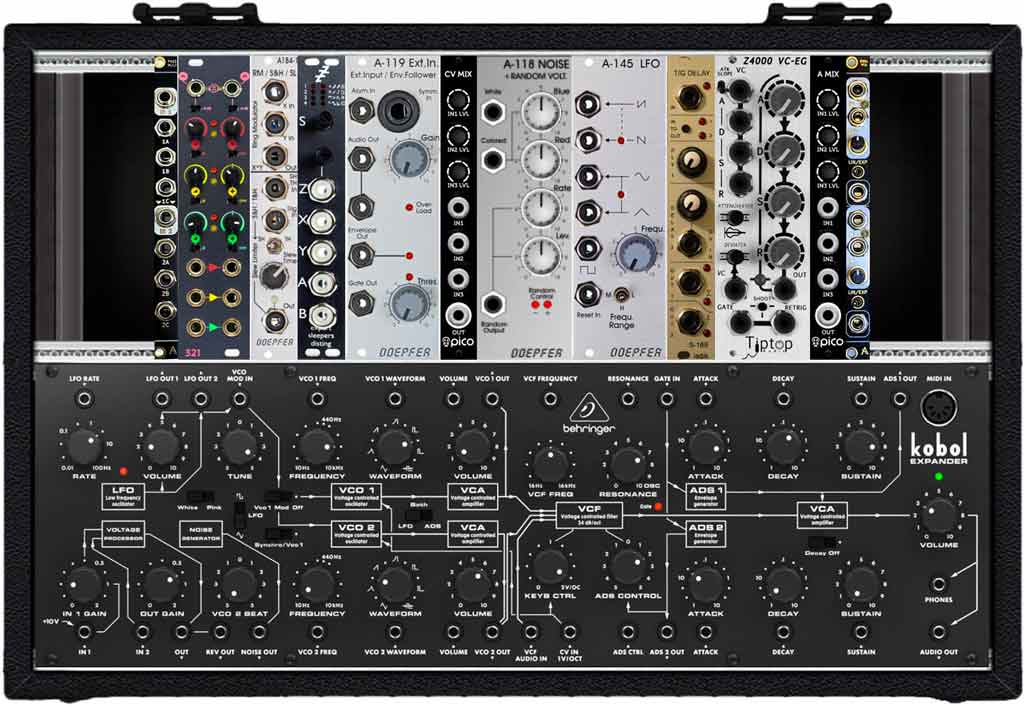
My Patreon channel covers live performance, studio, and compositional ideas in addition to – of course – modular synthesizer patching tricks. Here are some of the new posts I’ve written since the previous newsletter:
- Tales From the Road #05: Separation Anxiety: Right before I was supposed to start playing at Knobcon this year, I discovered that power to half of my modular had been disconnected. Never one to let a good crisis go to waste, I worked on schemes to make it harder for important power and data connections to accidentally become unplugged, which I share in this post. Available to all Learning Modular Patreon subscribers.
- Roli Seaboard 2 MPE Controller for Modular: As part of putting together the Bob Moog Foundation modular system mentioned above, I had to figure out how to get a Roli Seaboard 2 MPE controller to work with a modular synth. This post documents how I made it happen, and should serve as a template for getting other MPE controllers to work with your own modular system. Available to +5v and above subscribers.
- Track Breakdown: The Circles of Atlantis: I walk through my Knobcon performance and explain each sound and pattern as I introduce it, including patch notes. Available to +5v and above subscribers.
- Tales from the Road #06: My Ableton Live Master Set: I use a hybrid modular + desktop synth + computer setup for my live performances. The Ableton Live project grew to 58 tracks, plus 6 effects busses. In this article I break down what every track is doing, including interfacing with the modular – even for effects! Available to +5v and above subscribers.
- Recreating the Kobol Expander 2: Behringer has created an inexpensive clone of the vintage Kobol Expander semi-modular synth. It’s a very nice synth in its own right, but it could use a bit more to become fully featured. Kobol themselves released an Expander 2 that fleshed out those features, but there is no sign Behringer is going to clone that as well. So, I took it as a challenge to figure out how to recreate the Expander 2 with Eurorack modules; this may serve as a good template for how to expand other semi-modular synths as well. Free to everyone, to get a taste for what my Patreon content can be like.
Speaking of free, you can get free access to all of my articles for one week in exchange for trying out my Patreon page at the +5v subscription level. Here is the list of roughly 500 articles you will above access to – so subscribe and get reading! There is also an annual subscription option for the +5v level where you get access to an entire year for the price of 10 months.
Upcoming Events
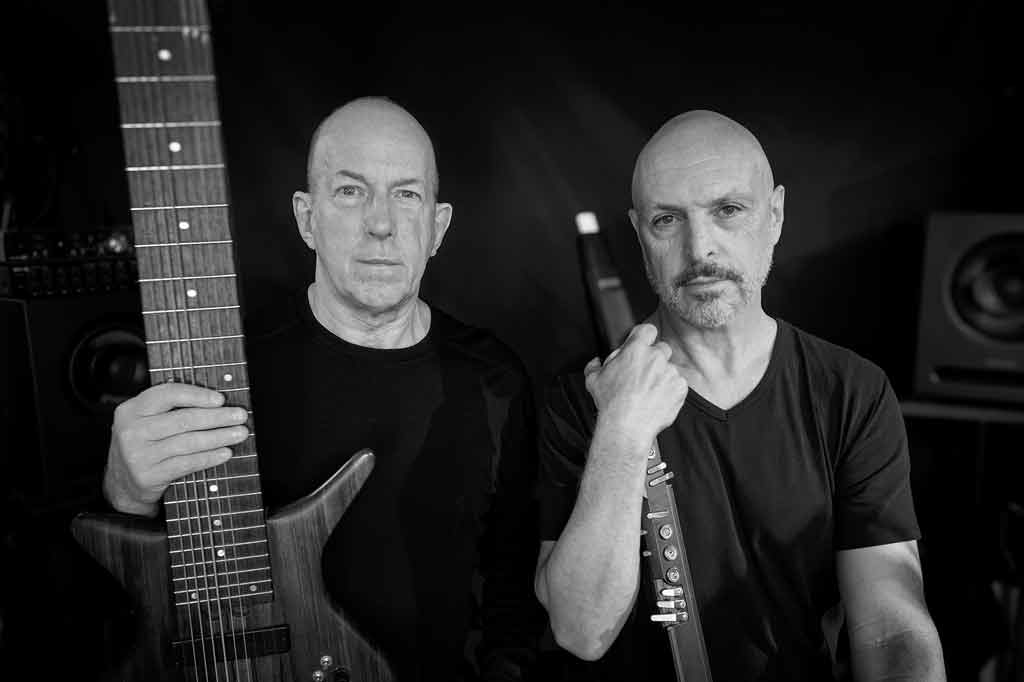
December 6, 7:30 PM, Fusion 708, Albuquerque, New Mexico
The new duo of Trey Gunn (Tu-Ner, ex-King Crimson, and master of the Warr Guitar) and David Forlano (stalwart of the Santa Fe avant jazz scene playing sax, EWI, and electronics) will be holding an album release party and concert for their debut effort – and I will be the opening act! You will also be treated to quadraphonic sound in a modified “in the round” environment, with video projections by John-Mark Collins of Wonder and Light. Click here for tickets and plan on a road trip – it will be a very special event.
This will be my last performance for 2025. I purposely have not scheduled anything yet for 2026, as I want to focus on studio work. However, I am still interested in tasty gigs as they arise in 2026 (and I’ve already started planning 2027); use the Contact form at the bottom of this page to get in touch if you’d like to discuss me being part of your event – playing, speaking, or both.
One More Thing…
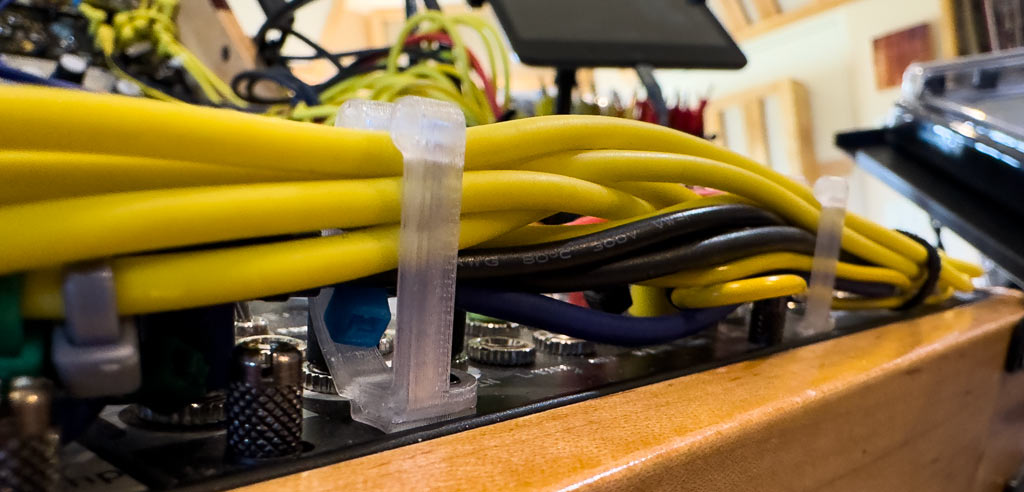
I try to keep the cables in my performance modular case organized so I can close the lid with everything patched, and also to see and tweak important controls while performing without cables getting in the way. I tried several different cable clips available on Etsy and from some modular vendors, and ran into problems with most of them: they broke too easily, or did not fit properly over rack rails or along the edges of a case. So, I took what I learned from those failures, and worked with my wife Trish to create our own refined design.
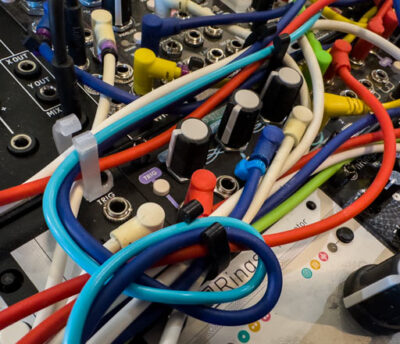 After a few rounds of development and testing, Chaos Clips were born, with my wife 3D printing them for others to use as well. Hundreds of sets have been sold by my brother Ronald and his company Starving Students Music Supplies on Amazon US. They have a 4.8 review rating, with reviewers commenting “these clips are a very essential utility for all Eurorack systems,” “very nicely designed,” and “perfect for 5U, 4U, 3U Modular synthesizers! Quality material and solid even for 1/4″ cables.”
However, Chaos Clips have been hard to get outside of the US. Therefore, Trish and is offering them for direct sale this holiday season – they make great stocking stuffers for modular users! – with special flat-rate shipping. The price is $10 USD for one pack of 10 black clips + screws or $8 per pack for 2 or more, plus $5 for shipping inside the US, $17 for Canada and Mexico, and $20 for the rest of the world – no matter how many packs you buy.
Want to order some? Get in touch using the Contact form at the bottom of this page with your shipping address, and I’ll email you back with how to pay via Zelle, Venmo, or PayPal. (A limited number of clear clips are also available; let me know if you prefer those instead of black, or want to mix-and-match.)
A friend recently asked others why we go through the trouble of releasing music when it’s so hard to make money at it, and especially during these turbulent times when there was so much else to worry about.
Aside from my own compulsion to share what I’ve learned, I was struck by a quote from the musician Bill Rieflin. He was asked why he was still touring with King Crimson even while he had terminal cancer. His reply was that he believed music had the possibility to bring grace into the world – and if you had that power, why wouldn’t you use it?
looking forward to a creative 2026 –
Chris